




Call Us
Office Hours
Monday
10:00 am - 7:30 pm
Wednesday
10:00 am - 7:30 pm
Friday
10:00 am - 7:30 pm
Saturday
10:00 am - 3:00 pm
Please enter your zip code or city, state below for door-to-door directions.

Tooth loss affects a large number of adults, and the impact goes beyond appearance — it can change how you eat, speak, and feel about your smile. Advances in implant dentistry have made it possible to replace one tooth or an entire arch with restorations that behave and look like natural teeth. These solutions are rooted in biology and precision planning, and they can restore function while preserving the long-term health of the jaw.
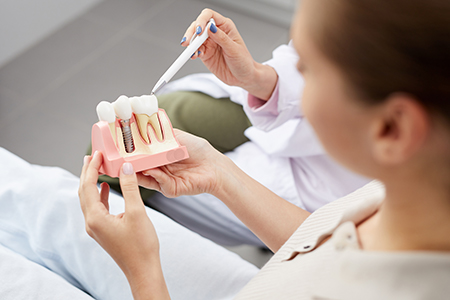
Dental implants replace the root as well as the crown of a missing tooth, which is what sets them apart from traditional bridges and removable dentures. Because an implant integrates with the jawbone, it provides a stable foundation for crowns, bridges, and denture attachments — stability that helps preserve bone and facial structure over time. For many patients, that means improved comfort, confidence, and oral function.
Implant dentistry is not a single procedure but a coordinated treatment pathway that includes evaluation, imaging, surgical placement, and prosthetic restoration. Each phase is planned to match a patient’s anatomy, health history, and aesthetic goals. When executed with careful planning and skill, the result can be a restoration that feels seamless — both for daily function and for long-term upkeep.
Because implants mimic the role of natural tooth roots, they restore chewing efficiency and speech more reliably than many removable solutions. Patients often report being able to enjoy a wider range of foods and speak without worrying about movement or slipping. Implants also remove the need to alter healthy adjacent teeth, which is sometimes required with traditional fixed bridges.
When a tooth is missing, the underlying bone no longer receives normal stimulation and may gradually resorb. A placed implant helps maintain that stimulation, slowing or preventing bone loss and helping preserve facial contours. This structural benefit contributes to both function and the long-term aesthetics of the face and smile.
Implant dentistry is versatile — there are pathways for replacing a single tooth, several teeth, or an entire arch. Decisions about which approach to use depend on factors like the number of missing teeth, bone volume, bite relationships, and the patient’s personal goals. Thoughtful selection of the restoration type leads to outcomes that meet expectations for stability, comfort, and appearance.
For one missing tooth, a single implant topped with a ceramic crown recreates the look and function of a natural tooth without altering neighboring teeth. This solution preserves surrounding structure and allows for independent maintenance of the restored tooth.
When two or more teeth are missing in a row, an implant-supported bridge can replace the teeth without relying on adjacent natural teeth for support. Strategically placed implants carry the load, while the bridgework restores alignment and chewing function.
For patients missing all or most teeth in an arch, a fixed implant-supported prosthesis anchored by a small number of implants can deliver a non-removable, natural-feeling replacement. This approach often allows immediate provisional teeth, followed by a definitive prosthesis once healing is complete.
For patients who prefer a removable option, implants can provide stable attachment points that dramatically reduce movement and improve function compared with conventional dentures. These hybrid solutions combine the benefits of implants with the convenience of removable prosthetics.
A successful implant outcome begins with a thorough clinical exam and imaging to evaluate bone volume, tooth alignment, and overall oral health. Medical history, lifestyle factors, and patient goals are all part of the planning conversation. Where needed, multidisciplinary collaboration — including periodontics or oral surgery — ensures the chosen approach fits each patient’s unique needs.
The surgical placement of an implant is typically performed under local anesthesia and, when appropriate, sedation options. After placement, implants need time to integrate with the bone — a process called osseointegration — before the final crown, bridge, or denture is attached. In selected cases, a temporary restoration can be placed immediately to maintain esthetics and function during healing.
Not every smile is immediately ready for implant placement. Conditions such as prior tooth loss, periodontal disease, or long-term denture wear can reduce available bone. In those cases, bone grafting or ridge augmentation can rebuild sufficient volume to support an implant. These procedures are well-established and expand the number of patients who can benefit from implant therapy.
Good overall oral health and consistent maintenance are key to the longevity of implant restorations. While implants themselves do not decay, surrounding tissues can develop inflammation if plaque is allowed to accumulate. Regular dental checkups, proper home care, and periodic professional cleanings help protect your investment and support lasting function.
Zhukovsky Dental combines modern diagnostic tools with clinical experience to tailor implant treatment to each patient’s needs. Our approach emphasizes clear communication, predictable techniques, and careful follow-through from planning to the final restoration. That means patients receive a plan that balances aesthetics, comfort, and long-term oral health.
Replacing missing teeth with implants is a process that rewards careful preparation and collaboration between patient and clinician. If you are considering implant dentistry, a consultation will clarify your options, outline the recommended steps, and answer questions about healing and expected outcomes. With appropriate planning, most patients can enjoy restorations that feel natural and perform reliably for years.
In summary, implant dentistry offers durable, bone-sparing solutions that restore function and confidence for many patients. If you’d like to learn more about whether dental implants are right for you, contact us for more information.
Dental implants are small biocompatible posts that replace the root portion of a missing tooth and provide a stable foundation for a prosthetic crown, bridge, or denture. Most implants are made from titanium or zirconia and are designed to integrate with the jawbone through a process called osseointegration. Integration creates a secure connection between bone and implant that restores function much like a natural tooth root.
The visible prosthetic attached to an implant is carefully matched to surrounding teeth for color, shape, and function, so the restoration looks and performs naturally. Because the implant supports the restoration directly, it preserves adjacent tooth structure and helps maintain jawbone volume over time. This combination of biological stability and prosthetic precision is why implants are used for single-tooth replacement as well as for supporting bridges and full-arch restorations.
Good candidates for dental implants are patients in generally good health with adequate jawbone volume and healthy soft tissues in the area to be treated. Important considerations include control of periodontal disease, stable systemic health, and habits that support healing such as avoiding tobacco or addressing unmanaged medical conditions. A comprehensive clinical exam and imaging study are required to determine whether implant therapy is appropriate for an individual patient.
Age alone is not a limiting factor; rather, candidacy depends on the state of oral tissues and overall health. When bone volume is insufficient or gum disease exists, pre-implant therapies like bone grafting or periodontal treatment can often create suitable conditions. The final determination is made after reviewing medical history, clinical findings, and the patient’s restorative goals during a consultation.
Treatment begins with a detailed evaluation that typically includes a clinical exam, dental impressions or digital scans, and three-dimensional imaging to assess bone quantity and critical anatomical structures. These diagnostic steps allow the dental team to develop a personalized treatment plan that outlines surgical placement, any necessary preparatory procedures, and the timing of provisional and final restorations. Clear communication about sequence and expectations helps patients understand each phase of care.
The surgical phase is usually performed with local anesthesia and, when appropriate, sedation to maximize patient comfort. After implant placement, a period of healing is required for osseointegration before the definitive crown, bridge, or prosthesis is attached; in selected cases a temporary restoration can be placed immediately to preserve aesthetics and function. Throughout the process the team monitors healing and adjusts the prosthetic design to ensure proper fit, bite, and appearance.
Initial recovery after implant surgery commonly involves mild to moderate swelling and discomfort that typically subsides within a few days to a week, and most patients return to normal activities quickly with appropriate post-operative instructions. Soft-tissue healing is generally complete in a matter of weeks, while full integration of the implant with bone often requires several months depending on the clinical situation. Pain can usually be managed with prescribed or over-the-counter medications and following simple care guidelines such as avoiding strenuous activity and eating soft foods for a short period.
Follow-up visits during the healing phase allow the clinician to evaluate osseointegration and address any concerns promptly. If a temporary restoration was placed, adjustments may be needed to optimize comfort and function while the implant integrates. Long-term function is typically restored after the definitive prosthesis is attached and the patient follows recommended maintenance practices.
Implants can support a broad range of restorations tailored to the number of missing teeth and patient goals, including single crowns, implant-supported bridges, fixed full-arch prostheses, and implant-retained removable dentures. Single crowns replace one tooth without altering adjacent teeth, while implant-supported bridges use strategically placed implants to carry multiple missing teeth in a row. For full-arch rehabilitation, a fixed prosthesis anchored by several implants can provide a stable, non-removable solution that closely mimics natural dentition.
Implant-retained removable dentures use attachments that allow the prosthesis to snap onto implants for improved stability and comfort compared with conventional dentures. The choice among these options depends on factors such as bone volume, bite relationships, esthetic requirements, and the patient’s functional needs. With careful planning, each restoration type can deliver predictable function and esthetics suited to the patient’s lifestyle.
Low bone volume and periodontal disease are common challenges but do not automatically preclude implant therapy; they often require staged treatment to establish a healthy, stable foundation. Bone grafting, ridge augmentation, or sinus elevation procedures can rebuild deficient bone in areas where implants are planned, while periodontal treatment is essential to control infection and inflammation before placement. These preparatory procedures are well-established and expand the number of patients who can safely receive implants.
Successful implant outcomes depend on resolving active gum disease and ensuring sufficient bone support for long-term stability. The treatment timeline may be extended to allow grafts and soft tissues to heal before implant placement, and a collaborative approach with specialists can be used when complex reconstruction is needed. A personalized assessment will clarify which interventions are recommended to achieve the desired restorative result.
Daily oral hygiene is essential for safeguarding implants; patients should brush twice daily with a soft-bristled toothbrush and clean around implant restorations using floss, interdental brushes, or water irrigation devices as recommended by the dental team. Professional maintenance visits for clinical exams and thorough cleanings are important to monitor peri-implant tissues and remove plaque and calculus that home care can miss. Maintaining good overall health and avoiding tobacco use also supports implant longevity.
Patients should be aware of early signs of soft-tissue inflammation such as redness, swelling, persistent bleeding, or increased probing depths around an implant and report these to their dentist promptly. When detected early, peri-implant mucositis and other issues can often be treated effectively with non-surgical therapies and improved hygiene. Regular radiographic and clinical evaluations help track bone levels and prosthetic integrity over time.
Dental implants replace both the tooth root and the visible crown or prosthesis, whereas traditional bridges rely on neighboring natural teeth for support and removable dentures sit on the gums without a root-like anchor. Because implants transfer chewing forces into the jawbone similarly to natural roots, they help preserve bone and facial contours that can deteriorate after tooth loss. Implants also avoid the need to alter healthy adjacent teeth, which is sometimes required for conventional bridgework.
Functionally, implants offer increased stability for eating and speaking compared with many removable options, and they reduce concerns about slippage or movement. Maintenance differs as well: implants require the same daily hygiene and periodic professional care as natural teeth, while removable prostheses may also need periodic relining or adjustment. The optimal choice for each patient depends on oral conditions, restorative goals, and professional recommendations.
Modern implant dentistry uses three-dimensional imaging (CBCT), digital scanning, and computer-guided surgical planning to improve accuracy in implant placement and to protect vital anatomical structures. Guided surgery allows implants to be positioned precisely to match the planned prosthetic outcome, which enhances esthetics and occlusion while reducing surgical variability. Digital workflows, including CAD/CAM fabrication of restorations, streamline communication between the clinical team and the dental laboratory for better-fitting prostheses.
Advances in implant surface treatments, materials such as ceramic abutments, and immediate provisionalization protocols also contribute to improved outcomes in appropriate cases. When combined with thorough diagnostics and experienced clinical technique, these technologies support predictable integration and long-term function. Patients benefit from more efficient treatment plans and outcomes that are tailored to their anatomy and restorative objectives.
To begin the implant process, schedule a consultation so a clinician can perform a complete oral exam, review your medical history, and obtain appropriate imaging to assess bone volume and anatomic considerations. During this visit the team will discuss restorative goals, outline any preparatory procedures that may be needed, and explain the anticipated sequence of care so patients understand what to expect at each stage. A clear plan supports predictable results and helps patients make informed decisions about their treatment.
If you would like to explore implant options, contact Zhukovsky Dental to arrange an evaluation in our Brooklyn office and learn which restorative pathways best match your needs. The consultation is an opportunity to ask questions about timelines, healing expectations, and maintenance protocols so you leave with a practical roadmap for care. Ongoing follow-up and professional maintenance will be part of that plan to help protect your investment in oral health.
Please enter your zip code or city, state below for door-to-door directions.